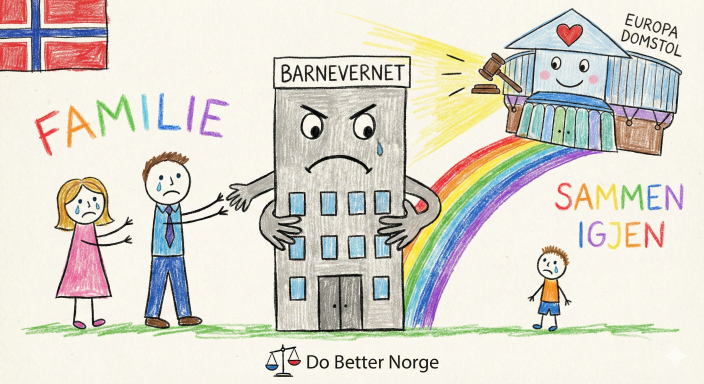
Topic: An analysis of the conflict between the Norwegian Child Welfare Services (Barnevernet) and the European Court of Human Rights regarding the right to family life.
Welcome back. Today we’re diving into a topic that has baffled legal experts and families alike for the better part of a decade. We are looking at Norway—a country usually at the top of every "best place to live" list—and asking a tough question: Why does it keep losing child welfare cases at the European Court of Human Rights?
Host 2:It really is a paradox. Since 2015, the European Court in Strasbourg—the ECtHR—has accepted dozens of cases against Norway regarding its child welfare services, known as Barnevernet. In a significant number of these, including Grand Chamber judgments, Norway has been found guilty of violating human rights [1, 2]. Specifically, they are violating Article 8 of the European Convention, which guarantees the "Right to Respect for Private and Family Life" [1, 3].
Host 1:So, what is the core of the disagreement? Is Norway just bad at protecting children?
Host 2:Actually, the argument is often that they are trying to protect children too much, to the point of excluding the parents entirely. The conflict comes down to two different philosophies. Norway’s system is historically "child-centric." They focus heavily on the child's need for stability and security immediately after removal [4]. The European Court, however, operates on a principle called the "ultimate aim of reunification" [5].
Host 1:Reunification. Meaning the goal should always be to get the kids back to their parents?
Host 2:Exactly. The ECtHR says a care order should be a temporary measure. The state has a "positive duty" to try to put the family back together as soon as reasonably feasible [5, 6]. The criticism against Norway is that they decide too quickly that a placement is "long-term," and once they decide that, they cut off contact to protect the child's "calmness" and attachment to the foster parents [7, 8].
Host 1:I see. And this leads us to the issue of visitation, or "contact rights," which seems to be central to these judgments.
Host 2:It is the central mechanism of the failure. In Norway, it became common practice to grant very limited visitation—sometimes only three or four times a year—for children in foster care [7, 9]. The logic was: "Let the child settle in with the foster family; don't confuse them." But the European Court pointed out that this creates a self-fulfilling prophecy [5, 10].
Host 1:A self-fulfilling prophecy? How so?
Host 2:Well, if you only let a parent see their child six hours a year, the bond naturally breaks. Then, three years later, the state argues, "We can't return the child because they aren't attached to the parents anymore." The Court calls this "cementing" the separation [5]. In the famous Strand Lobben case from 2019, the Grand Chamber ruled that Norway failed to conduct a "genuine balancing exercise." They focused so much on the child's attachment to foster parents that they completely ignored the state's duty to facilitate reunification [11, 12].
Host 1:That Strand Lobben case was a turning point, wasn't it?
Host 2:Huge. The Court criticized the authorities for relying on outdated expert reports and failing to actually test whether the mother’s parenting skills had improved [12, 13]. Essentially, they made a permanent decision (adoption) based on old evidence, without giving the biological family a fighting chance.
Host 1:There is also a cultural dimension here. We have to talk about the Abdi Ibrahim case.
Host 2:Yes, this is another major loss for Norway. It involved a Somali refugee mother whose child was placed in a Christian foster home [14, 15]. The mother wanted the child to maintain ties to his Muslim faith and Somali culture. The Norwegian system, again focusing on "stability," allowed for adoption by the foster family, effectively severing those cultural roots [16, 17].
Host 1:And Strasbourg stepped in?
Host 2:They did. They ruled that Norway violated Article 8 because they failed to take into account the mother’s wish to preserve her son’s cultural and religious identity [18, 19]. The state has an obligation to try to find a culturally compatible placement, or at least ensure contact that preserves those roots [18].
Host 1:So, is Norway listening? Are they changing?
Host 2:They are trying. The Supreme Court of Norway has started adjusting its rulings to align with the ECtHR, and a new Child Welfare Act came into effect in 2023 [20, 21]. This new law explicitly mentions the "biological principle" and the need to view care orders as temporary [20, 22]. But critics argue that the "administrative culture"—the mindset of the social workers on the ground—is much harder to change than the law itself [23].
Host 1:It sounds like a clash between a system that thinks it knows best for the child, and a human rights court reminding them that you can't just erase biological families in the pursuit of "stability."
Host 2:That’s the perfect summary. The European Court acknowledges that states have a "margin of appreciation"—discretion to make their own choices—but when it comes to permanently cutting family ties, that margin is very, very narrow [24, 25]. And Norway keeps stepping over the line.
Log in to post comments.

No comments yet.