Reconnecting Roots: Psychological Strategies for High-Conflict Family Reunification
🌐EN
📅February 17, 2026
💡 How to use: Use zoom buttons or scroll wheel to zoom in/out. Click and drag to pan around when zoomed. Double-click to zoom in. Press Reset to return to original view.
Case Study: A 10-Year-Old's Journey from Zero Contact to Relational Healing
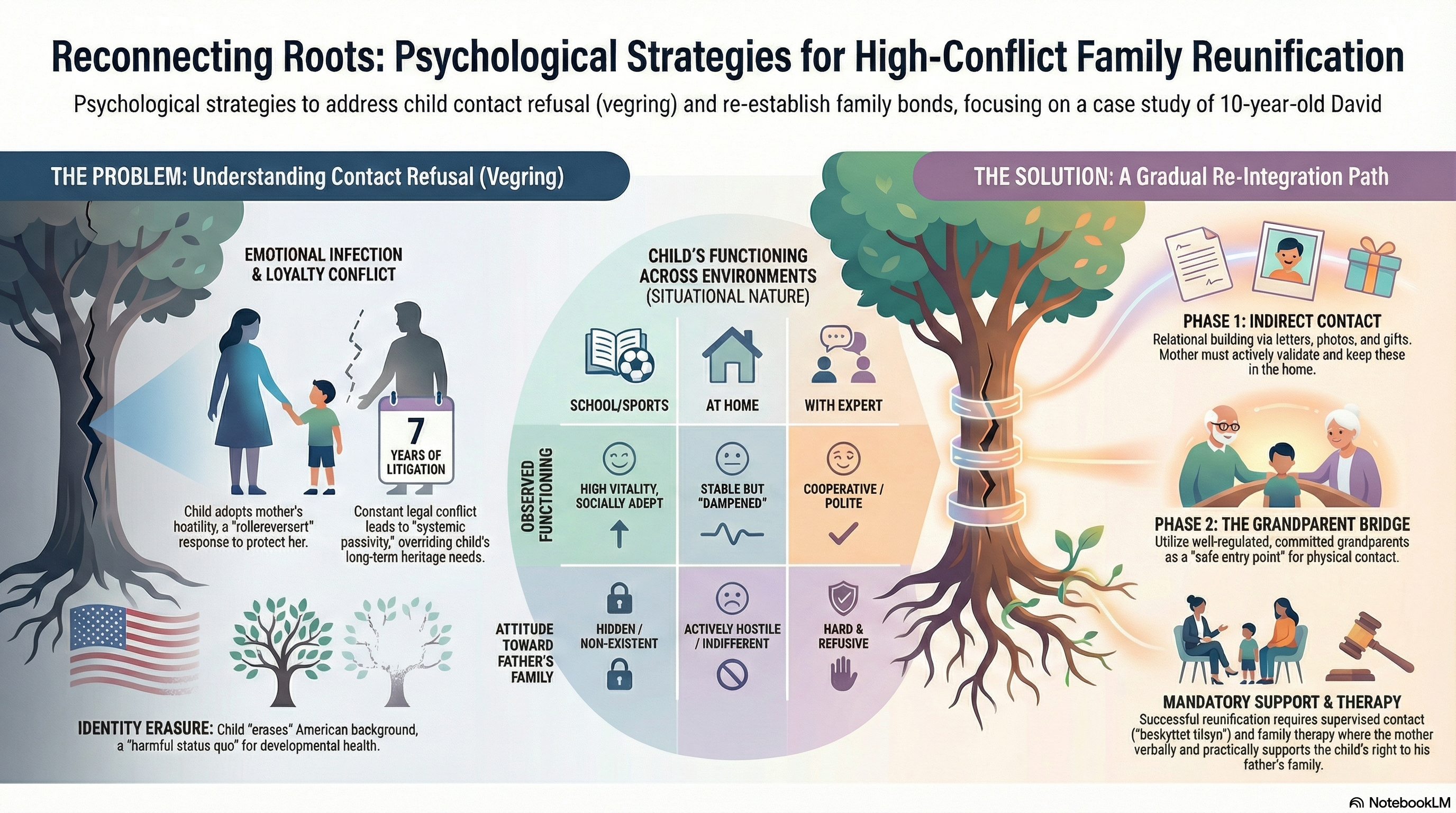
This detailed infographic presents a comprehensive clinical case study of 10-year-old David, who has experienced zero parental contact for an extended period following high-conflict separation. The analysis examines the psychological mechanisms behind contact refusal—specifically emotional infection, loyalty conflict, and bifurcated functioning (where the child performs well in some environments but exhibits rigid rejection in family contexts). It proposes a gradual re-integration pathway featuring Phase 1: Indirect Contact, Phase 2: Grandparent Bridge, and Phase 3: Direct Supervised Contact, grounded in attachment theory and therapeutic jurisprudence.
🧩 The Problem: Understanding Contact Refusal ("Veering")
📋 Clinical Profile: 10-Year-Old David
Presenting Issue: Complete rejection of paternal contact, identifying as "100% Norwegian" despite American-Norwegian heritage. David parrots his mother's negative statements about his father verbatim, showing no independent reasoning or nuanced understanding.
Key Observation: David functions normally at school, with peers, and in structured activities—demonstrating that the rejection is relationship-specific, not a global developmental issue.
💔 Emotional Infection & Loyalty Conflict
David has absorbed his mother's distress and hostility toward his father through emotional contagion. To reduce cognitive dissonance, he has taken an extreme "loyalty stance," completely rejecting the father to align with the custodial parent.
🏫 Functioning Across Environments
Critical Diagnostic: David's age-appropriate social skills, academic performance, and emotional regulation in non-family settings prove the rejection is not rooted in developmental trauma but in relational dysfunction.
🚫 Identity Erasure ("100% Norwegian")
David has been taught to reject his American heritage entirely, a form of identity foreclosure that impairs healthy self-concept development and creates long-term identity confusion.
🌱 The Solution: A Gradual Re-Integration Path
The proposed intervention uses a phased, trauma-informed approach to restore David's relationship with his father while minimizing emotional distress:
Phase 1: Indirect Contact
Goal: Re-introduce the father's presence without performance pressure.
Method: Asynchronous communication (letters, photos, video messages) that David can engage with at his own pace. This normalizes the father's existence and begins to challenge the "all-bad" narrative.
Phase 2: The Grandparent Bridge
Goal: Use paternal grandparents as a "safe bridge" to reduce threat perception.
Method: Supervised visits with grandparents in neutral settings. Children are often less defensive about extended family, allowing relational repair to begin indirectly before direct father-son contact.
Phase 3: Supported Physical Contact
Goal: Establish direct father-son interaction with therapeutic oversight.
Method: Brief, structured visits in therapeutic settings with gradual increases in duration and autonomy. Mandatory support therapy (individual and family) to process emotions and prevent regression.
🔬 Evidence-Based Foundations
Attachment Theory (Bowlby, Ainsworth): Prolonged separation from a primary caregiver disrupts secure attachment patterns, creating long-term relational difficulties and identity confusion.
Family Bridges Program (Warshak, 2010): A structured, court-ordered therapeutic intervention that has demonstrated success in reunifying alienated children with rejected parents.
Loyalty Conflict Resolution (Johnston & Roseby, 1997): Children in high-conflict divorces often adopt extreme positions to reduce cognitive dissonance—therapeutic intervention is needed to free them from this bind.
Bifurcated Functioning as Diagnostic (Kelly & Johnston, 2001): When a child functions well in non-family contexts but shows rigid rejection in family relationships, this indicates relational dysfunction, not developmental trauma—supporting therapeutic reunification rather than continued separation.
⚠️ The Cost of Inaction
Maintaining zero contact during critical developmental periods (ages 7-12) is not neutral—it actively causes harm:
Identity Foreclosure: Denying David access to half his heritage prevents healthy identity formation and creates long-term confusion about self-concept.
Attachment Insecurity: Zero contact cements the child's distorted belief system, making future reunification exponentially more difficult with each passing year.
Loyalty Bind Reinforcement: Continued separation teaches David that extreme loyalty (rejecting one parent entirely) is acceptable and necessary—a pattern that will damage future relationships.
Developmental Harm: Research shows that children who lose contact with a parent experience increased anxiety, depression, and difficulty forming secure adult relationships.
🎯 Therapeutic Goals & Success Metrics
The intervention aims to achieve the following measurable outcomes:
Cognitive Shift: David develops a more balanced narrative about both parents, replacing "all-bad" thinking with nuanced understanding.
Reduced Anxiety: Decreasing physiological stress responses (measured via self-report and behavioral observation) when discussing or engaging with the rejected parent.
Identity Integration: David begins to acknowledge and explore his bicultural heritage, demonstrating healthy identity development.
Autonomous Contact: Gradual transition to self-directed contact (within age-appropriate boundaries) without coercion or excessive anxiety.
Long-Term Relational Health: Preventing the entrenchment of avoidant attachment patterns that would impair David's future relationships and psychological wellbeing.
We use cookies to enhance your browsing experience, serve personalized content, and analyze our traffic. By clicking "Accept All", you consent to our use of cookies.
⚙️
Cookie Settings
Essential Cookies
Required for the website to function properly. These cannot be disabled.
Analytics Cookies
Help us understand how visitors interact with our website.
Marketing Cookies
Used to track visitors across websites to display relevant advertisements.

Comments (0)
Please log in to post comments.