Your Right to Know: A Guide to Accessing Public Information in Norway
🌐EN
📅February 17, 2026
💡 How to use: Use zoom buttons or scroll wheel to zoom in/out. Click and drag to pan around when zoomed. Double-click to zoom in. Press Reset to return to original view.
Freedom of Information in Norway: A Step-by-Step Guide to Your Legal Rights
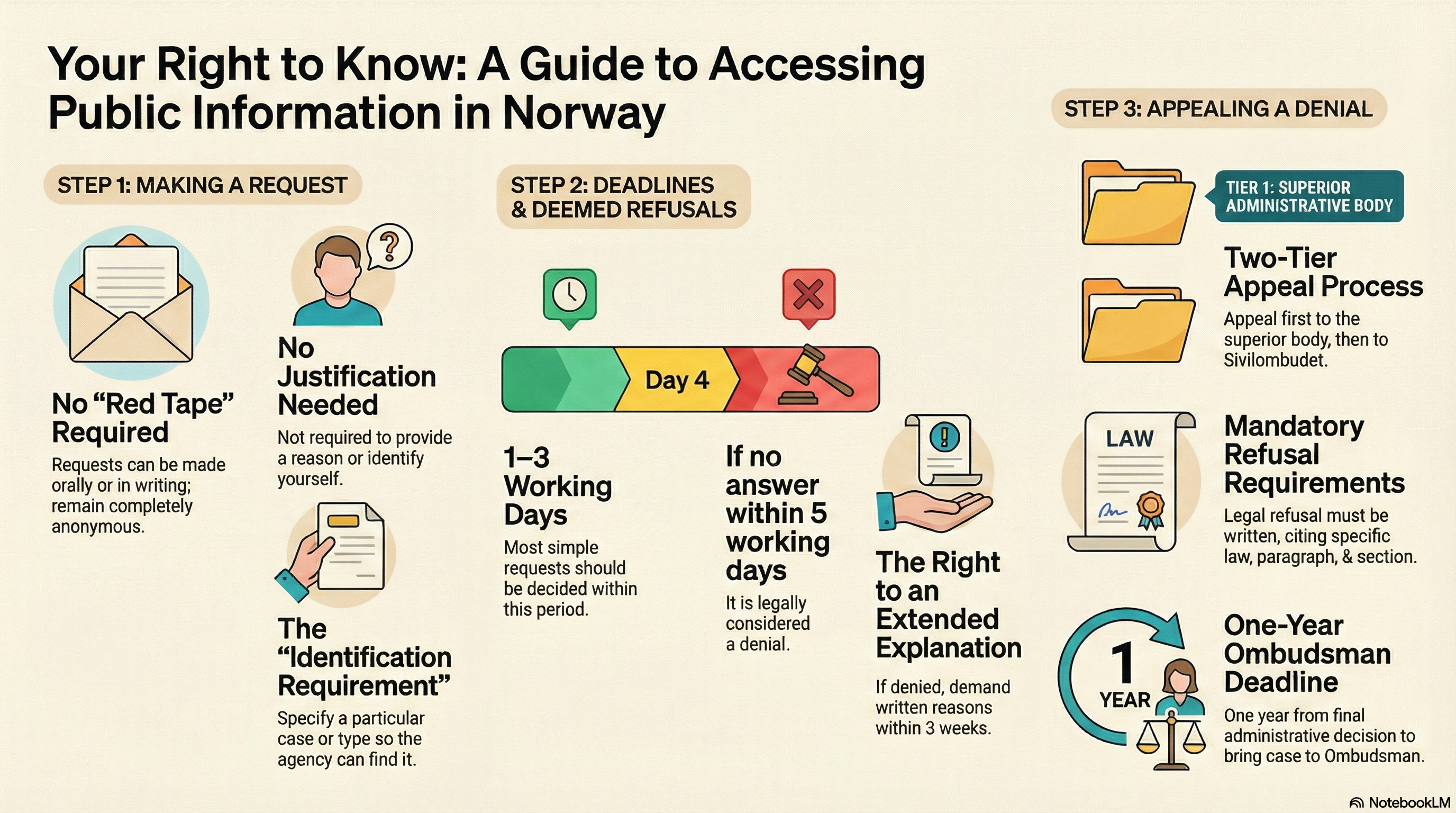
This comprehensive infographic explains your legal right to access public information in Norway under the Offentleglova (Freedom of Information Act). Norway's transparency framework is one of the strongest in the world, granting citizens, residents, and even non-residents the right to request documents from public authorities without needing to justify their interest. This guide outlines the three-step process for making requests, understanding deadlines, and appealing denials—plus critical information about the two-tier appeal system and the one-year Ombudsman deadline for bringing cases to Norway's independent oversight body.
📋 Step 1: Making a Request
✉️ No "Red Tape" Required
You can request public documents orally, in writing, or via email—no formal application required. Simply identify yourself (name and contact) and describe the documents you're seeking with reasonable specificity.
🔓 No Justification Needed
Under Norwegian law, you do not need to explain why you want the information. The burden is on the agency to justify any denial, not on you to justify your request.
📝 The "Identification Requirement"
Agencies may ask you to identify yourself to process the request and send responses. However, anonymous requests are generally accepted unless the agency has legitimate reasons to verify identity (e.g., preventing abuse of the system).
⏰ Step 2: Deadlines & Deemed Refusals
📅 Day 4: Initial Response Deadline
The agency must respond to your request within 4 calendar days (not business days). If the request is simple, you should receive the documents immediately or within this timeframe.
📆 1-3 Working Days: Extended Review
For complex requests requiring review of multiple documents or legal analysis, the agency may take up to 3 working days to respond. They should notify you if additional time is needed.
❌ If No Answer in 5 Days = Denial
If the agency does not respond within 5 working days, your request is legally considered denied. This "deemed refusal" allows you to proceed directly to the appeal process without waiting indefinitely.
⚖️ Step 3: Appealing a Denial
Norway has a two-tier appeal system plus access to an independent Ombudsman. Here's how it works:
Tier 1: Superior Internal Authority
If your request is denied, you can appeal to the agency's superior internal authority (e.g., department head, director). This is an internal review within the same organization.
Tier 2: Appeal Board (if applicable)
Some agencies have specialized appeal boards or committees. If the internal appeal is denied, you may have a second chance to appeal to this body before escalating to external oversight.
🕐 The Right to an Extended Explanation
If your appeal is denied, the agency must provide a detailed written explanation citing the specific legal grounds (e.g., privacy exemptions, security concerns). Generic "not in public interest" denials are insufficient.
🛡️ The Ombudsman: Independent Oversight
If your appeals are exhausted or you believe the agency acted improperly, you can bring your case to the Norwegian Parliamentary Ombudsman (Sivilombudet) or the Data Protection Authority (Datatilsynet, for privacy-related denials). Critical Deadline: You must file your complaint within one year of the final denial. The Ombudsman has the power to investigate, issue binding recommendations, and publicly criticize agencies for non-compliance.
✅ Mandatory Refusal Requirements
If the agency denies your request, the refusal must meet these legal standards:
Written Justification: The agency must cite specific exemptions under the Offentleglova (e.g., §13 privacy protection, §14 business confidentiality, §20 internal deliberations).
Proportionality Test: Even if an exemption applies, the agency must demonstrate that disclosure would cause significant harm. Vague or speculative harms are insufficient.
Partial Disclosure: If only part of a document is exempt, the agency must redact the protected sections and release the rest—they cannot withhold the entire document.
Right to Review: You have the right to appeal the refusal and request independent review of the agency's decision.
🌍 Norway's Transparency Framework in Context
Norway is consistently ranked among the top 5 countries globally for government transparency and freedom of information:
Strong Presumption of Openness: Norwegian law presumes that all government documents are public unless specifically exempted. This "open by default" approach contrasts with systems where the burden is on the requester to prove public interest.
Broad Definition of "Public Authority": The law applies not only to ministries and agencies but also to municipalities, state-owned companies, and even private entities performing public functions.
Low Barriers to Entry: No fees, no formal applications, no need to justify your interest—making transparency genuinely accessible to all, not just journalists or lawyers.
International Comparison: Norway's framework is modeled on similar transparency laws in Sweden, Finland, and Denmark, all of which rank among the world's most open governments.
⚠️ Common Pitfalls & How to Avoid Them
Too Vague: Requests like "all documents about [topic]" may be rejected as overly broad. Be as specific as possible about dates, document types, and subject matter.
Missing the Deadline: If the agency doesn't respond in 5 days, don't wait indefinitely—file an appeal immediately treating it as a deemed refusal.
Not Following Up: Agencies sometimes delay or ignore requests hoping you'll forget. Polite but persistent follow-up emails can make a significant difference.
Accepting Weak Denials: If an agency cites a vague "internal deliberation" exemption without explaining why disclosure would harm decision-making, appeal immediately. The law requires specific, fact-based justifications.
Missing the One-Year Ombudsman Window: Once the final denial is issued, you have exactly one year to bring your case to the Ombudsman. Missing this deadline means you lose your right to independent oversight.
📚 Legal Framework & Key Resources
Primary Law:Lov om rett til innsyn i dokument i offentleg verksemd (Offentleglova) – Freedom of Information Act
Oversight Bodies: The Norwegian Parliamentary Ombudsman (Sivilombudet), Data Protection Authority (Datatilsynet)
International Standards: Norway is a signatory to the Council of Europe Convention on Access to Official Documents and the UN Convention on Access to Information.
Practical Guides: The Norwegian government provides free guides in multiple languages at regjeringen.no explaining how to make FOI requests.
Legal Aid: If you believe your rights have been violated, organizations like Norges Juristforbund (Norwegian Bar Association) and Norsk Presseforbund (Norwegian Press Association) offer free or low-cost legal advice.
We use cookies to enhance your browsing experience, serve personalized content, and analyze our traffic. By clicking "Accept All", you consent to our use of cookies.
⚙️
Cookie Settings
Essential Cookies
Required for the website to function properly. These cannot be disabled.
Analytics Cookies
Help us understand how visitors interact with our website.
Marketing Cookies
Used to track visitors across websites to display relevant advertisements.

Comments (0)
Please log in to post comments.