
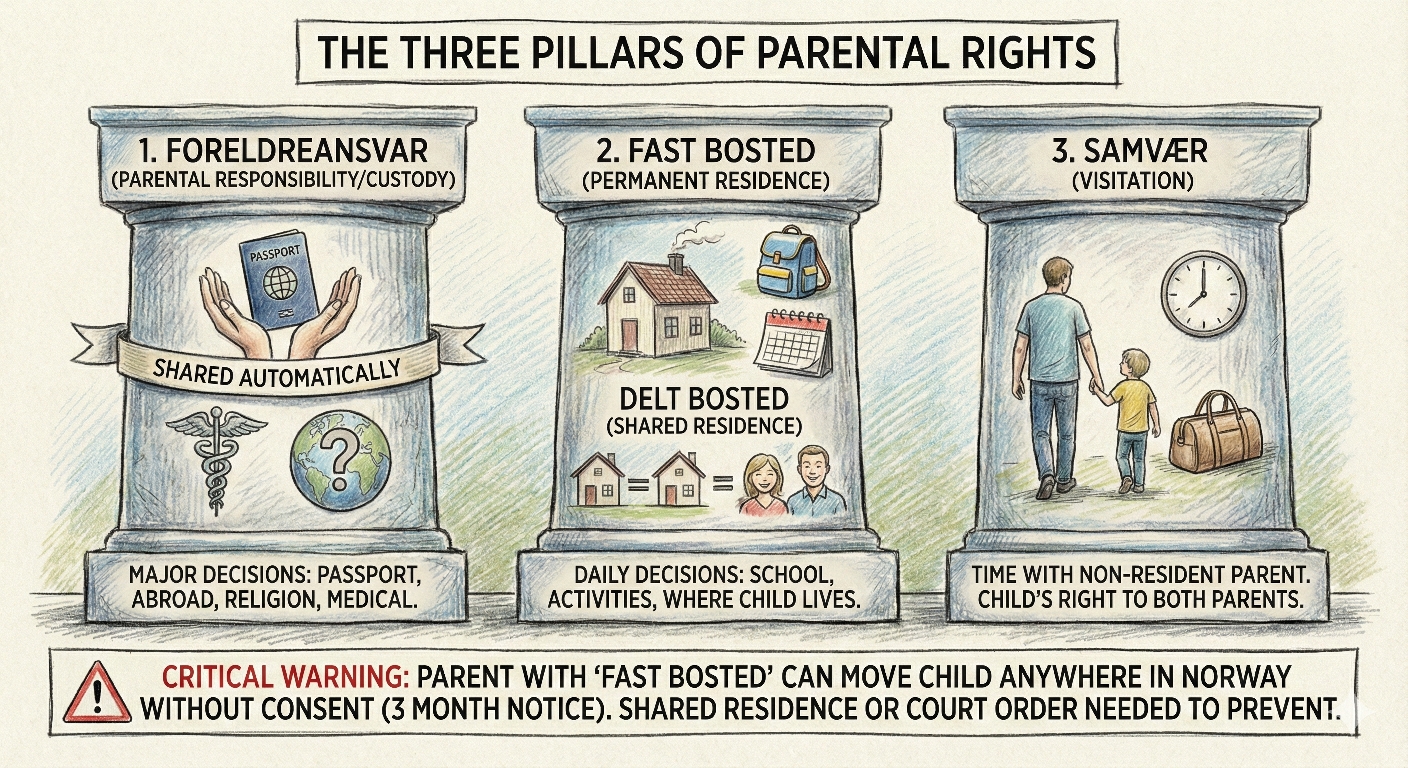
The Three Pillars of Parental Rights: A Strategic Guide
In the Norwegian legal system, "custody" is not a singular legal status. Under the Children Act (Barneloven), parental authority is surgically divided into three distinct pillars. Misunderstanding the technical boundaries of these categories is the most common reason parents in Norway unintentionally lose the ability to influence their child's upbringing or prevent a relocation.
Understanding the Legal Taxonomy
Norway distinguishes between long-term legal authority, daily residential power, and the right to physical contact. Each carries a different level of veto power over the child's life.
1. Foreldreansvar (Parental Responsibility)
Regulated by Barneloven § 30, this pillar represents the legal "guardianship" and the duty to make major, life-altering decisions. Since January 1, 2020, shared responsibility is the automatic legal default for all parents, regardless of whether they were married or living together at the time of birth.
- Scope of Decision Power: Decisions regarding passport applications, moving the child abroad (permanently or for travel), choice of name, religious upbringing, and consent to major medical procedures/surgeries.
- The Veto: If you have shared Foreldreansvar, the other parent cannot legally change the child's citizenship or move the child to another country without your written consent.
2. Fast Bosted (Permanent Residence)
This is the "Administrative Power" pillar, governed by Barneloven § 37. It is the most powerful status regarding the child's day-to-day life. Many parents mistakenly believe that having Foreldreansvar allows them to block local changes, but that power actually resides here.
- Daily Authority: The parent with "Fast Bosted" (the residential parent) has the sole authority to decide the child's kindergarten, school choice (SFO/AKS), and participation in local leisure activities.
- Delt Bosted (Shared Residence): Under § 36, parents can agree on—or the court can order—Shared Residence. In this case, neither parent has the "final word" on daily matters; both must agree on schooling and local residency.
3. Samvær (Visitation / Contact)
Governed by Barneloven § 42 and § 43, this pillar represents the child's right to maintain a relationship with the parent they do not live with. It is important to note that Samværsrett is legally described as the child's right, which the parent has a duty to facilitate.
- "Ordinary Visitation" (Vanlig samværsrett): Unless otherwise agreed, the law defines this as one afternoon a week, every other weekend, 14 days in the summer, and alternating Christmas and Easter holidays.
- The Enforcement Gap: A common critique of the Norwegian system is that while Samvær is a right, the residential parent often faces minimal consequences for sabotage. Enforcing these rights often requires a burdensome process through the Namsmannen (Bailiff) for "coercive fines" (tvangsmulkt).
CRITICAL WARNING: The Move-Away Loophole
This is the single most dangerous legal trap for non-residential parents. Under Section 37, the parent with Fast Bosted has the unilateral right to decide where in Norway the child lives. This means they can move from southern Norway to the Arctic north (2,000km away) without your consent.
The "3-Month" Notice: The moving parent must give 3 months' notice. However, this is merely a procedural requirement to allow for mediation. The notice itself does not stop the move. If you do not win a court injunction (midlertidig forføyning) or a change-of-residence lawsuit before the child is moved, your visitation rights will be rendered practically impossible due to distance.
Do Better Norge Strategy:
- Insist on "Delt Bosted": Never agree to "Fast Bosted" for the other parent in a private agreement if there is any risk of relocation. Shared Residence is your only legal lock on the child's location within Norway.
- Act Fast on Relocation Notices: If you receive a notice of intent to move, do not wait for the mediation date. File a petition for an injunction immediately to keep the child in the current school district while the case is reviewed.
- Formalize the Agreement: Ensure your Samværsavtale (Visitation Agreement) is detailed. Vague terms like "visitation as agreed" are unenforceable in the event of a conflict.
Official Sources and References:
- The Children Act (Barneloven): Official English Translation - Lovdata
- Directorate for Children, Youth and Family Affairs: Bufdir Guide on Residence and Contact
- Government Insight: Agreements on Permanent Residence and Visitation
Comments (0)
Please log in to post comments.
No comments yet. Be the first to comment!