
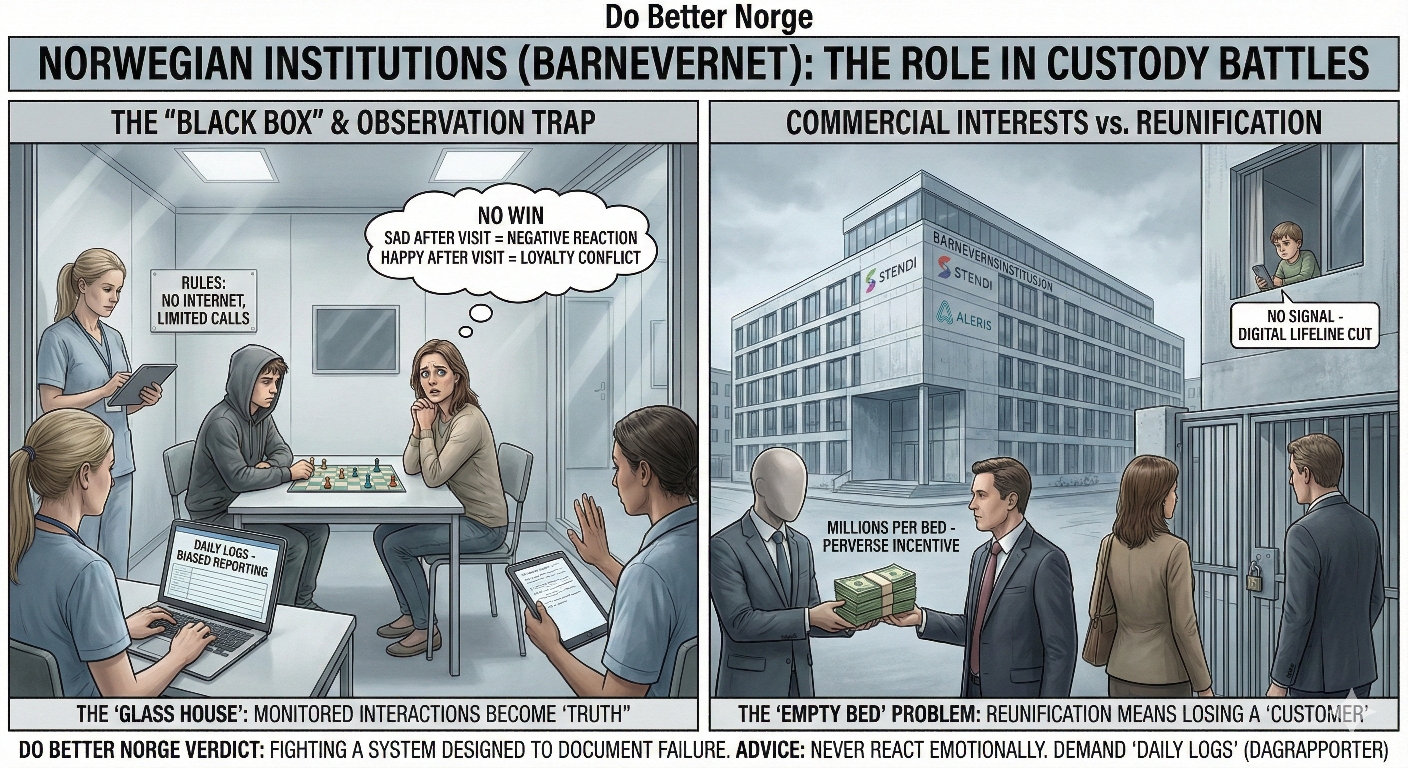
Norwegian Institutions: The "Black Box" of Child Custody
When a child is taken by Barnevernet, they are often placed in an institution (barnevernsinstitusjon) rather than a foster home, especially if they are teenagers or have "complex needs." For parents fighting to get their children back, the institution is not a neutral shelter—it is often an active opponent.
1. The "Observation Trap" (Rapportering)
The most dangerous aspect of an institution for a parent is that everything is evidence.
- Biased Reporting: Staff at institutions write daily logs about the child. If the child is sad after a visit with you, they often report it as "negative reaction to parent." If the child is happy, they might report it as "loyalty conflict." Parents effectively cannot win.
- The "Glass House": Unlike a home, an institution is a workplace. Your interaction with your child is monitored by shift workers who may lack high-level psychological training but whose notes become "truth" in the Tribunal (Nemnda).
2. Commercial Interests vs. Reunification
A massive percentage of Norwegian institutions are run by private commercial actors (e.g., Stendi, Aleris) or non-profits, paid by the state (Bufetat).
- The "Empty Bed" Problem: Critics argue there is a perverse incentive. An institution gets paid millions of kroner per year to keep a bed filled. Reuniting a child with their parents means losing a "customer." While staff generally care for kids, the systemic structure fights against reunification.
- Isolation: Institutions often enforce strict rules on phone usage and internet, effectively cutting the "digital lifeline" between parent and child under the guise of "protection."
3. "Samvær" (Visitation) in Institutions
Visitation that takes place inside an institution is fundamentally artificial.
- Hostile Environment: Meeting your child in a meeting room, watched by two staff members taking notes, creates stress. The institution then uses this stress to argue that "visitation is burdening the child" and should be reduced.
- The "Loyalty" Weapon: If a child expresses a desire to go home, institutions often categorize this as the child being "manipulated" by the parents, rather than a genuine wish. This allows them to override the child's voice.
Do Better Norge Verdict: If your child is placed in an institution, you are fighting a system designed to document failure. Advice: Never react emotionally to staff. Assume every phone call is logged. Demand to see the "daily logs" (dagrapporter) regularly via an access request (innsyn) so you can correct errors before they reach the court.
Sources:
Comments (0)
Please log in to post comments.
No comments yet. Be the first to comment!